Fractals of Justice: African Fractals, Spirituality & Community
In a world where individualism and linear systems seem to dominate, the wisdom of African fractal societies offers a radical, inspiring reimagination of what spirituality, ethics, and community can mean. Imagine a village where the very layout—the rings within rings, the self-similar paths and boundaries—embodies lessons about fairness and reciprocity. As artists and seekers, exploring these patterns isn’t just about math or mesmerizing visuals; it’s about unveiling blueprints for living in harmony with ourselves, each other, and the planet.

The Hidden Geometry: Fractals Rooted in African Societies
When most hear “fractals,” sprawling neon Mandelbrot sets or the swirling shapes of digital art might spring to mind. Yet fractals, with their endlessly recursive, self-similar forms, owe much of their inspiration to the living world—and to cultures who wove these patterns into daily life long before computers or chaos theory existed.
Ethnomathematician Ron Eglash brought global attention to the remarkable intentionality of African fractal design. Across West, Central, and Southern Africa, both architecture and social structures are built upon recursive patterns:
- Village layouts: Settlements often take the form of rings within rings—an inside reflecting the outside, individual houses echoing the organization of the entire community.
- Royal compounds: Power flows through a nested geometry where the chief’s home, satellite dwellings, and community meeting spaces all mirror one another, transmitting a quiet message: every part participates in the shape and wellness of the whole.
- Boundaries and paths: The lines drawn aren’t random—they structure access, privacy, and gathering, organically guiding relationships and responsibilities.
These fractal designs do more than please the eye. They encode ways of being together—resolving conflict, sharing resources, welcoming newcomers—into the very land beneath people’s feet. Geometry here isn’t merely beautiful; it is ethical, practical, and sacred.
Fractals, Circulation, and the Ethic of Reciprocity
Modern Western systems, whether in economics or urban design, often follow a centralized logic: a straightforward pipeline from many to one. Such linear, extractive models channel resources and power upward until little remains for those below.
Fractal societies subvert this. Their spatial patterns distribute flows—the path through a compound echoes the path a story or shared meal might take, circling back, looping outward, returning again. This is no accident; it is a principle made visible, every scale reflecting a ethic of return and reciprocity:
- Rotating credit associations: These community banks allow each member to access pooled funds in turn, guaranteeing that resources cycle rather than accumulate in one place.
- Assemblies and decision-making: Governance echoes geometry: dialogue proceeds in nested circles, each node feeding back into the system. Disputes are resolved not through edict but through spatially encoded participation.
- Kinship networks: Family, clan, and village relationships aren’t linear hierarchies but webs—each person a node in a pattern that stretches and morphs, but always returns to the source.
This fractal circulation resists the logic of extraction. Instead of resources flowing one way and never returning, as in many modern economies, responsibility and wealth are redistributed across levels, nourishing the community much like a tree cycles nutrients from root to leaf and back again.
Sacred Geometry as Living Ethics
Too often, sacred geometry is admired solely as a visual or meditative tool. African fractal societies invite us to ask: what if geometry is also ethical architecture—a way of designing justice, not just contemplation?
Here, the forms aren’t just beautiful symbols to gaze upon; they are blueprints for how to gather, share, and decide together. The spiral path leading to a chief’s house, the concentric plazas of a gathering space, even the sequence of doorways and fences—all these express, through form, how people relate and interact.
In this model, spirituality transcends the individual. It becomes communal and spatial, lived in the choices of pathways, gathering places, and boundaries. The layout of a single home echoes the moral geometry of the village itself; the microcosm mirrors the macrocosm.
From Individual Mindfulness to Communal Presence
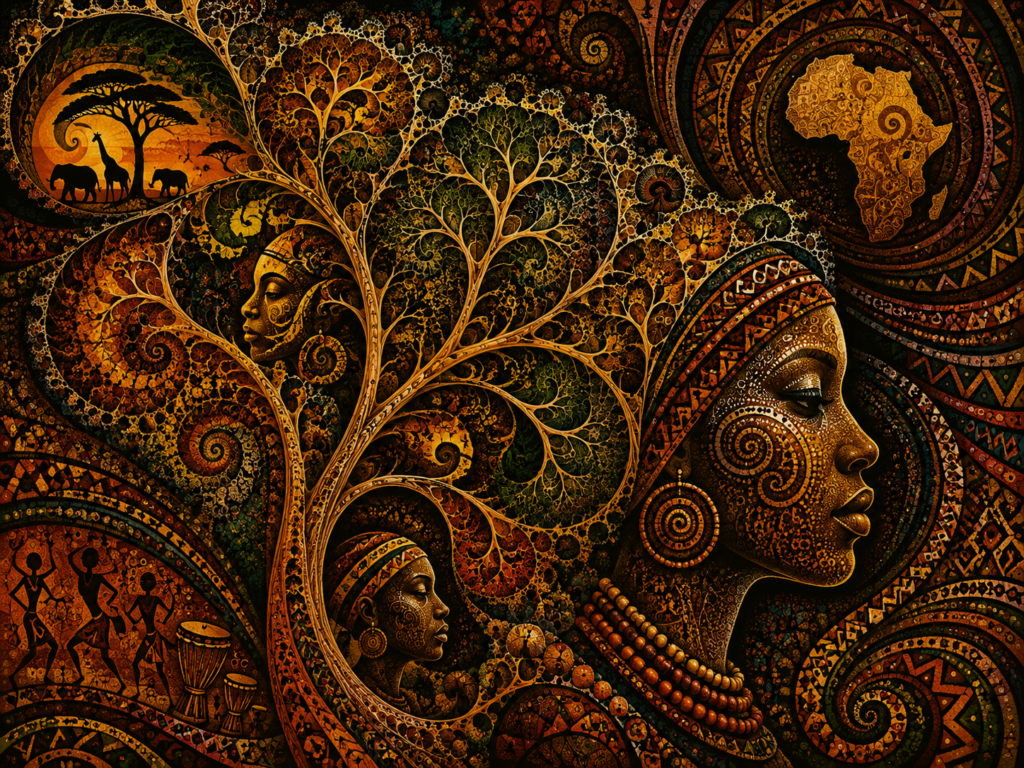
In popular spiritualities, inner peace and personal awakening are often the center. But fractal societies remind us that spirituality is also about how we structure our relationships—how fairness and accountability aren’t simply meditated upon but are built into daily life through place and ritual. The geometry of the village becomes an ally in justice, guiding feet and hearts alike.
Fractals Across Science and Spirit
It is a striking convergence: the scientific and spiritual both find resonance in fractal patterns. Modern chaos theory revels in the mathematics of “the part echoing the whole,” describing everything from neural networks to coastlines. Spiritual traditions—East and West—whisper the same truth: “As above, so below.” Mandalas, yantras, the geometric diagrams of mystical cultures, all echo this symmetry.
But the African fractal village is a living mandala. Unlike theoretical diagrams, its patterns are walked, inhabited, and enacted every day. The part and the whole are not just metaphors—they are how the village breathes and thrives.
Implications for Modern Artists and Seekers
As digital and fractal artists, or simply spiritual explorers, there is much to glean:
- Nested identity: Each of us is a self within a family, a community, a society—each layer echoing the shape of the other, each dependent on the well-being of its neighbors.
- Interactive patterns: How might our art, our meditation spaces, or our digital communities reflect not just aesthetic beauty, but the principles of inclusion, feedback, and cycling return?
- Building with intention: Geometry can encode ethics; the design of even a virtual gallery or a group gathering becomes a practice in justice-making.
Designing Fractal Communities for a New Spirituality
The lessons of African fractal societies might be more relevant now than ever. In a world frayed by burnout, hyper-competition, and loneliness, we are called to reimagine spirituality as something more than a solo journey. What if the community itself—digital or physical—was a living fractal?
Consider these practical pathways:
- Community Circles: Organize group meditations or discussions in spirals or concentric circles, allowing the geometry itself to guide fairness, voice, and connection.
- Resource Sharing: Design support networks (think mutual aid or creative collectives) as rotating, self-similar patterns, so help and wealth circulate and return.
- Art and Ritual: Create fractal-inspired installations or rituals that reinforce returning, sharing, and nested belonging, making the invisible geometry of community visible and tangible.
- Feedback Loops: Build regular cycles of reflection into your initiatives or workplaces—mimicking the cyclical feedback found in fractal societies—so wisdom and correction flow at every level.
By anchoring spirituality in the nested patterns of justice, geometry, and community, we bring forth a new vision: one where art is activism, meditation is communal, and beauty serves as a compass toward fairness.
Weaving New Fractals of Belonging
The fractals of African villages are not only a testament to mathematical sophistication but a living, breathing alternative to the extractive, isolating systems so many of us yearn to transform. They show us that sacred geometry can be much more than abstract meditation—it is ethical, practical, and powerfully communal.
As artists and seekers, let us take up the challenge: to design our spaces, projects, and relationships as fractals of justice and reciprocity. Whether we create with paint, pixels, or community gatherings, may our patterns ripple outward to shape a more beautiful, equitable world.
How can you nurture fractal justice where you are? Start by reimagining your gatherings, networks, or creative spaces in fractal terms—cycles of giving, returning, and nested belonging.