Sacred Geometry and Intuition: Your Hidden Compass for Creativity
Why is it that certain patterns seem to whisper a silent yes as we make decisions in our lives and art? Sacred geometry is often admired for its mesmerizing beauty or mystical aura—but beneath these appearances, it offers something subtler yet more profound: practical guidance for creative decision-making. In times when intuition is prized as the truest guide, could geometry be its hidden compass? As artists and seekers, we’re invited to both see and feel how ancient shapes can direct our choices, reveal meaning, and bring coherence to chaotic modern life.

The Ancient Roots: Geometry as the Blueprint of Order
In the winding corridors of history, sacred geometry appears not only as ornament, but as a living language of order. Pythagoras, the enigmatic Greek philosopher, taught that number, ratio, and proportion shape not just objects, but reality itself. For the Pythagoreans, the universe pulsed in harmonious measure—a cosmic symphony where living “in proportion” was a matter of both beauty and ethics.
Plato, too, mapped meaning onto form. The five Platonic solids—cube, tetrahedron, octahedron, dodecahedron, and icosahedron—weren’t just static models. Each embodied elements of the cosmos (earth, fire, air, water, ether), mirroring creation’s very architecture. To contemplate a geometric figure was to glimpse the divine design.
In Eastern traditions, the story runs just as deep. Across the mandalas of Buddhism or the yantras of Hinduism, geometry acts as a map for meditation, a navigational tool for spiritual ascent, and a visualization of the entire cosmos. Here, the energy of perfect symmetry and proportional balance isn’t a mere abstraction—it’s woven directly into the practical work of consciousness and contemplation.
Core Forms as Archetypes for Decision-Making
Long before we analyze or explain, shapes speak to us—each with a distinct archetypal energy. When we learn to recognize and activate these energies, geometry can become a toolkit for navigating choices, both in art and everyday life.
The Circle: Wholeness, Completion, and Cycles
The circle, ancient and unbroken, is the sigil of unity. When you find yourself revisiting old projects or contemplating closure, let the circle be your guide. It asks: What would bring wholeness here? Is it time to end this loop, or protect your energy by drawing a boundary as sure as a round perimeter?
The Triangle: Direction, Focus, and Will
Sharp, dynamic, and forward-leaning, the triangle speaks of purpose. It distills momentum—pointing the way towards action or risk. In creative work, invoking the triangle can bring clarity: Where will you channel your attention? Which priority rises to the apex? As with the upward-pointed pyramidal flame, sometimes progress means choosing a direction and moving, even if imperfectly.
The Square: Stability, Structure, and Boundaries
The square provides the ground beneath our feet—a pattern of safety, home, and containment. Concrete decisions about money, living space, or the foundations of a long-term project draw on this archetype. Is it time to shore up your boundaries? Have you built your creative or spiritual practice on a stable base, or are the corners wobbling?
The Spiral: Growth, Change, and Nonlinear Progress
No journey moves in a straight line. The spiral echoes the growth of galaxies, shells, and even our fingerprints—nature’s choreography of expansion and return. When contemplating decisions about personal growth, learning, or transformation, the spiral encourages patience. Progress here is evolutionary, not sudden; every loop brings a new perspective, even as we revisit familiar ground.
The Vesica Piscis: Union, Relationship, and Liminal Space
Where two circles overlap, a new lens emerges. The Vesica Piscis is a portal for partnership and collaboration. If you’re negotiating shared projects or navigating the uncertainty between “me” and “us,” this archetype offers clues for finding common vision and thriving on fertile, if ambiguous, ground.
Try this: when facing an important decision, sketch the shape that resonates most. What is its mood? Its advice? Sometimes the geometry that feels right points to the solution your mind is still wording.
Modern Science: Patterns, Perception, and Aesthetic Intuition
While the ancients honored proportion as a sacred code, modern science is just beginning to explain its silent influence on our choices. Across disciplines, evidence suggests humans are wired to sense harmony, balance, and pattern at speeds far faster than conscious reasoning.
Designers and architects have long leaned on geometric systems—the golden ratio, modular grids, and recurring motifs—not merely for their history, but because these structures consistently feel good. There’s a subtle “rightness” to their proportions, an intuitive comfort that emerges even before we name it. Studies in cognitive science back this up: people’s brains light up when they encounter symmetry and balance, and they make judgments about beauty and comfort in milliseconds.
Consider how brands deploy circles for inclusiveness, triangles for dynamism, or grids for trust. Our eyes—and hearts—respond immediately. When we experience a work of art, a logo, or even a room as ‘harmonious’, we’re not just seeing a pretty image; we’re sensing a hidden geometry that aligns with our nervous system and implicit needs.
Artful Alignment: Sacred Geometry as a Mirror for Inner Wisdom
What happens when we invite these shapes off the page and into the fabric of creative living? Arranging geometry isn’t just about achieving outward symmetry; it’s a practice of listening to our own inner harmony, our gut-level intuition.
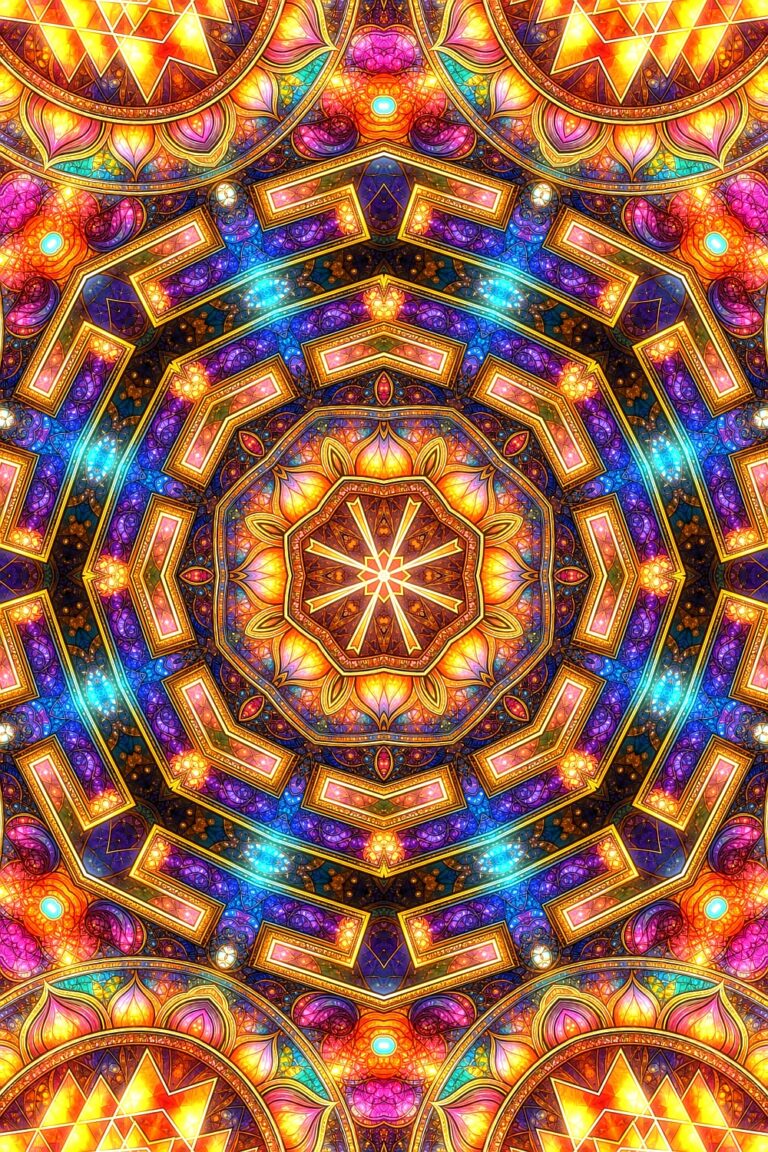
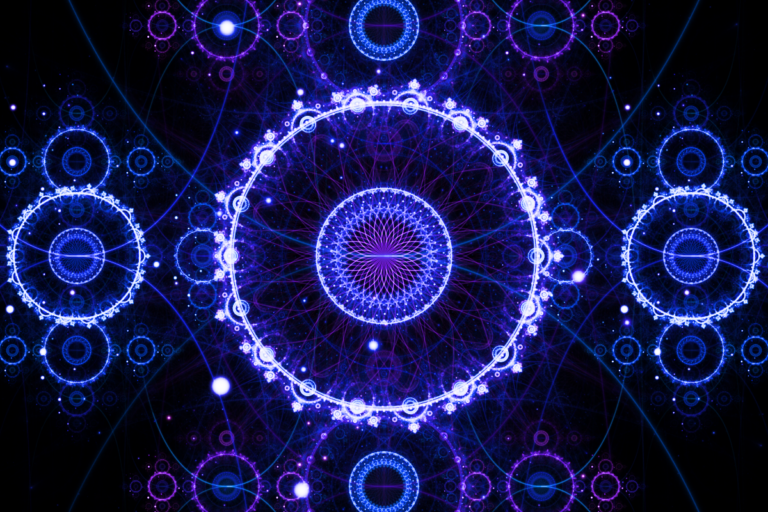
For example, in composing a digital fractal or painting a mandala, every miniature decision—from the distance of two points, to the closure of a loop, to the scale of a motif—is a rehearsal of intuition. Which element settles the image into a satisfying whole? Where is the tension that asks to be resolved, or the area that wants just a touch more complexity?
This practice is more than aesthetics. Each choice made in the studio, garden, or spreadsheet mirrors a deeper process: Do I want greater contrast or more harmony? Where should my boundary be firm, and where can I invite overlap or ambiguity? Am I spiraling towards growth, or do I need the solid ground of the square?
If you find yourself overwhelmed by possibilities—too many notes, colors, or life options—try pausing to tune into which geometric archetype the situation embodies. Sometimes, stepping back into this archetypal language helps bypass mental noise and taps into a purer, more trustworthy compass.

Practical Methods: Bringing Sacred Geometry Into Daily Choices
How might you put these patterns to work as navigational aids, not just decoration? Here are a few simple practices to reconnect with the wisdom of sacred geometry in your creative or daily life:
- Shape Journaling: When stuck, sketch or trace a shape (circle, triangle, square, spiral, or vesica piscis) and ask: What does this remind me of? What decision or feeling emerges as I contemplate it?
- Compositional Inquiry: Next time you arrange a room, design a page, or even set your schedule, ask which geometric principle would feel most supportive. Are you seeking unity (circle), flow (spiral), or focus (triangle)?
- Inner Compass Meditation: Focus on your heart or gut center while visualizing your chosen shape. Invite a question that’s alive for you—about art, love, work or growth. Let your instincts and bodily sensations respond in the presence of this form. Record what arises.
- Archetype Mapping: In collaborative projects, discuss which geometric motif captures your team’s vision. Use it to clarify roles, define boundaries, and inspire creative breakthroughs.
Over time, you’ll notice a shift: choices begin to feel less arbitrary and more aligned, as if guided by a wisdom both ancient and immediately present.
Listening for the Shape of Yes
Sacred geometry, at its essence, is more than a visual trend or mystical curiosity. It is a living, breathing grammar for aligning inner and outer worlds. For those who create—whether on the canvas, in code, or in daily intention—these forms offer more than decoration. They reveal how to navigate toward coherence, possibility, and meaning. When intuition calls, let shape and structure be your tuning fork: geometry becomes your hidden compass, whispering where to turn, what to build, and, sometimes, when to simply be whole.
If you’re curious to deepen this dialogue between art, geometry, and intuition, begin by noticing which patterns catch your breath this week. Journal with a shape, meditate with a mandala, or bring a geometric motif into your daily rituals. The more you listen, the clearer your inner compass will become.
Which geometry guides you today? Share your insights or artworks in the comments below!